
Johnson County Divorce Decree Search
Johnson County divorce decree records are kept by the District Clerk in Cleburne, the county seat located south of Fort Worth in the Dallas-Fort Worth metroplex. The county has grown steadily in recent years, and the court system handles a solid volume of family law cases. Online access is available for case index information, and the clerk's office also accepts in-person and mail requests for certified copies of final decrees and other divorce documents. This page covers how to search records, what to bring, and what the filing process looks like in Johnson County.
Johnson County Overview
Johnson County District Clerk
The District Clerk's office in Johnson County is the official record keeper for all divorce cases. The office handles new filings, stores case files, and provides copies of documents on request. Two district courts serve Johnson County: the 18th and the 249th Judicial District Courts. Both handle family law cases including divorce, child custody, and property disputes.
Johnson County's location in the southern DFW metro area means it sees a substantial number of filings each year. Many residents commute into Tarrant or Dallas counties for work but live in Johnson County, making this court a regular stop for family law cases. The clerk's office has online access through the county's records portal as well as the statewide re:SearchTX system.
| Office | Johnson County District Clerk |
|---|---|
| Address | 2 N Main St, Cleburne, TX 76033 |
| Phone | (817) 556-6200 |
| Hours | Monday through Friday, 8:00 AM to 5:00 PM |
| Website | johnsoncountytx.org |
Mail requests are accepted. Send a written request with both party names, the approximate filing year, and payment for copy fees. Make checks payable to the Johnson County District Clerk. The office can confirm what types of payment they accept when you call ahead.
How to Search Johnson County Divorce Records
Johnson County has online access for case index information through johnsoncountytx.org. You can also use the statewide re:SearchTX portal to look up basic case details. These online tools show docket entries, party names, and case status. To get actual document images or certified copies, you need to contact the clerk's office directly or visit in person.
When searching for a Johnson County divorce record, it helps to have:
- Full legal name of one or both parties at the time of the divorce
- The year the case was filed, or an approximate range
- The cause number if it is available
- The type of copy you need (plain vs. certified)
In-person searches can be done at the courthouse in Cleburne. Public access terminals may be available in the clerk's office for basic case lookup. Bring your ID. Staff can assist with locating older files that may not be fully indexed online. Certified copies are ready at the window once the file is found and the fee is paid.
Note that Mansfield is a qualifying city that straddles both Johnson and Tarrant counties. Divorce filings for Mansfield residents go to the county where that person has lived for 90 days, so some cases may be in Tarrant County's records instead. If you cannot find a case in Johnson County, try checking Tarrant County as well.
Divorce Filing Process in Johnson County
Filing for divorce in Johnson County requires you to meet Texas residency rules. Under Texas Family Code section 6.301, at least one spouse must have lived in Texas for at least six months and in Johnson County for at least 90 days immediately before filing. This applies whether or not you were married in Texas.
Texas allows no-fault divorce. The most common ground is "insupportability" under Texas Family Code section 6.001. That ground does not require proof of wrongdoing. You simply state that the marriage can no longer continue due to conflict or discord. Fault grounds are available but require more evidence and may affect how the court divides property.
After you file the Original Petition for Divorce, the 60-day waiting period begins. Under Texas Family Code section 6.702, no divorce can be granted until that period passes. For agreed divorces where both parties have signed off on all terms, the case can often be finalized soon after the 60 days run. Contested cases go through discovery, possible mediation, and trial if needed.
The eFileTexas system lets attorneys and self-represented parties file documents electronically with Johnson County courts. Check if your filing type is eligible for e-filing before you go to the courthouse.
Fees for Johnson County Divorce Records
Filing a new divorce case in Johnson County costs around $325 for cases without children. Cases involving children run higher due to additional required filings. The exact amount depends on the current fee schedule set by the District Clerk. Call the office or check their website before you file.
For certified copies of existing divorce records, the standard Texas copy fee structure applies. Plain copies run about $1 per page. Certified copies add a $5 certification fee per document on top of the per-page cost. If you need multiple documents certified separately, each one carries its own certification charge.
Low-income filers can request a fee waiver using the Statement of Inability to Afford Payment of Court Costs. This form is available at the courthouse or from txcourts.gov/rules-forms. The judge decides whether to grant a waiver after reviewing your financial situation. TexasLawHelp.org has step-by-step guidance on completing this form.
What Johnson County Divorce Records Contain
A Johnson County divorce file contains all documents filed from the start of the case through post-decree orders. The Original Petition for Divorce starts the file. It names both parties, states the grounds, and asks the court for specific relief. Everything filed after that, including citations, responses, temporary orders, and the final decree, becomes part of the permanent record.
The Final Decree of Divorce is the primary document most people need. It is the signed order from the district court judge. The decree covers property division under Texas Family Code Chapter 7, conservatorship and possession arrangements for any children, child support computed under Texas Family Code Chapter 154, and spousal maintenance if applicable. The decree is what banks, employers, and government agencies require to act on changes arising from the divorce.
Additional documents you may find in the file include income withholding orders for child support, Qualified Domestic Relations Orders for retirement accounts, and parenting plan agreements if those were submitted separately. Financial disclosures submitted during the case may be sealed depending on what the judge ordered at the time of filing.
Legal Resources for Johnson County Residents
Legal Aid of NorthWest Texas serves the DFW area including Johnson County. They offer free legal help to qualifying low-income residents in family law cases. Call (888) 529-5277 or visit their website for eligibility information and to request assistance. They can help with divorce forms, custody matters, and related issues.
The State Bar of Texas runs a lawyer referral service at (800) 252-9690. You can also search for attorneys at texasbar.com. For court forms and self-help divorce guides, go to texaslawhelp.org. Official Texas court forms are available free at txcourts.gov/rules-forms.
The Texas State Law Library divorce guide covers the full process including residency rules, grounds, forms, and post-decree modification procedures.
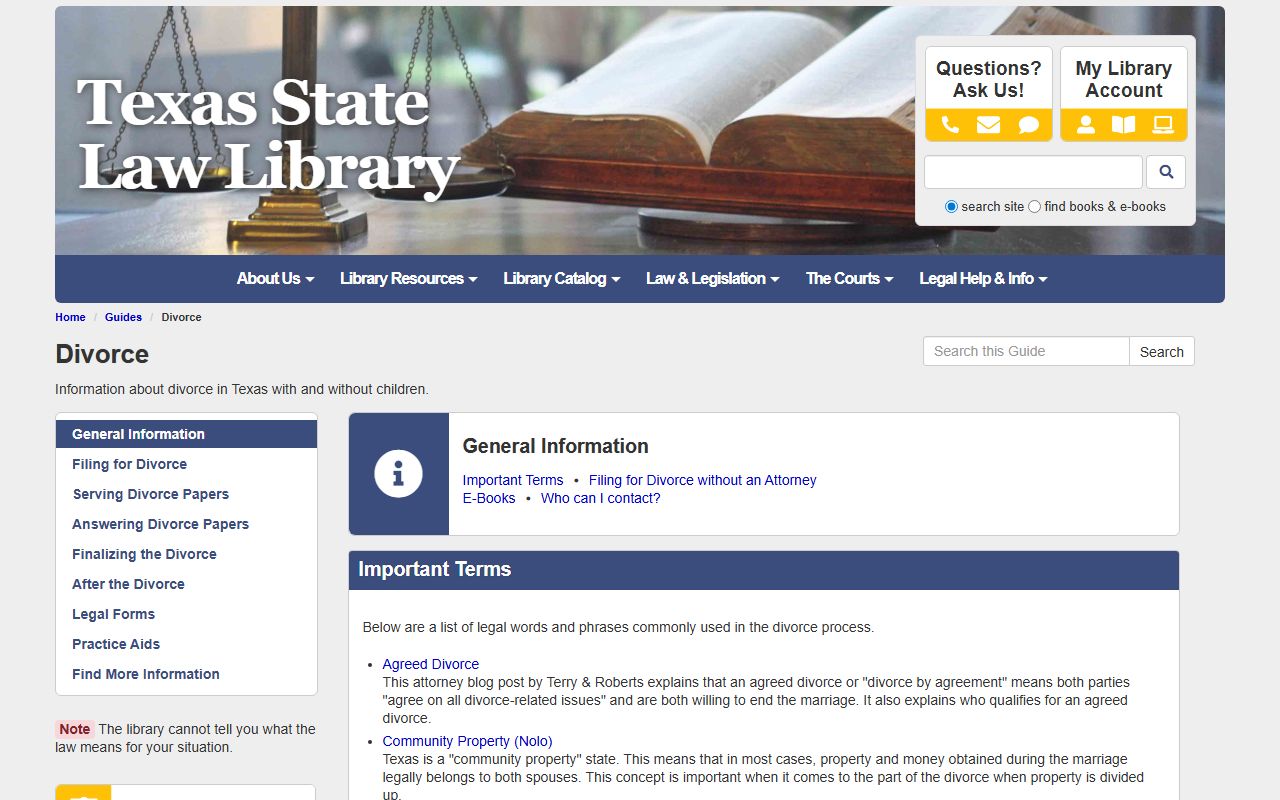
The State Law Library guide is free and written for people who want to understand how Texas divorce works without needing a law degree.
Cities in Johnson County
Mansfield is the only qualifying city in Johnson County by population threshold. Note that Mansfield straddles both Johnson and Tarrant counties, so divorce filings for Mansfield residents may be in either county depending on their specific address and where they have lived for 90 days.
Other communities in Johnson County include Cleburne, Burleson, Joshua, Keene, and Alvarado. All divorce cases in the county go through the Johnson County District Court in Cleburne.
Nearby Counties
Johnson County borders Tarrant, Ellis, Hill, Bosque, Erath, and Hood counties. If you are not sure which county applies to your case, check where you have lived for the past 90 days.
Tarrant County | Ellis County | Hill County | Hood County | Erath County