
Uvalde County Divorce Decree Records
Uvalde County divorce decree records are kept at the District Clerk's office in the county seat of Uvalde, Texas. The District Clerk is the official custodian of all family law case files in the county, including divorce filings, final decrees, and related court documents. If you need to search for a divorce case filed in Uvalde County, or if you need a certified copy of a final decree, the District Clerk at the Uvalde County Courthouse is where you go. Uvalde County records go back to 1856, giving the office one of the longer record histories in the region.
Uvalde County Overview
Uvalde County District Clerk
The Uvalde County District Clerk maintains all divorce records filed in the county. The courthouse is located at Courthouse Plaza in Uvalde, Texas. The main courthouse phone is (830) 278-3918. The District Clerk is the right office to call for divorce case information, certified copies of final decrees, and questions about how to file in Uvalde County. The County Clerk handles a separate set of records including birth, marriage, death, probate, court, and land records going back to 1856.
Uvalde County is a South Texas county in the Winter Garden region. It was incorporated in 1850, originally from Bexar County. The District Clerk's records cover divorce and court proceedings that date back to the county's early years. For most people looking up a divorce decree from the past several decades, the records should be accessible through the courthouse or the statewide online systems. Call the courthouse before visiting to confirm current office hours and what you need to bring for a records request.
| Office | Uvalde County Courthouse |
|---|---|
| Address | Courthouse Plaza Uvalde, TX 78801 |
| Phone | (830) 278-3918 |
| Hours | Monday through Friday, regular business hours |
Search Uvalde County Divorce Records
The statewide re:SearchTX system is the best online option for looking up Uvalde County divorce records. It covers Texas district courts and is free to use. You can search by party name or cause number and see basic case information including docket entries and court assignments. For recent filings, this is a fast way to confirm a case exists and find the cause number before calling the courthouse.
For full document access, including certified copies of a final decree, contact the Uvalde County District Clerk directly at (830) 278-3918. Staff can search by party name or case number. For mail requests, include the names of both parties, approximate year of the divorce, your contact information, payment, and a self-addressed stamped envelope. The clerk can confirm the accepted payment methods when you call. In-person visits to the courthouse on Courthouse Plaza are also an option during regular business hours.
For older records going back to Uvalde County's earliest days, some documents may be in physical storage rather than a digital system. Allow extra time for requests involving cases from before the digital era. The District Clerk can advise you on how to access historical records when you contact the office.
The Texas Department of State Health Services at dshs.texas.gov maintains a statewide divorce index. If you only need a quick confirmation that a divorce took place without getting the full case file, a DSHS verification letter is an option worth considering.
eFile Texas allows attorneys and self-represented parties to file documents into Uvalde County district court cases without visiting the courthouse.
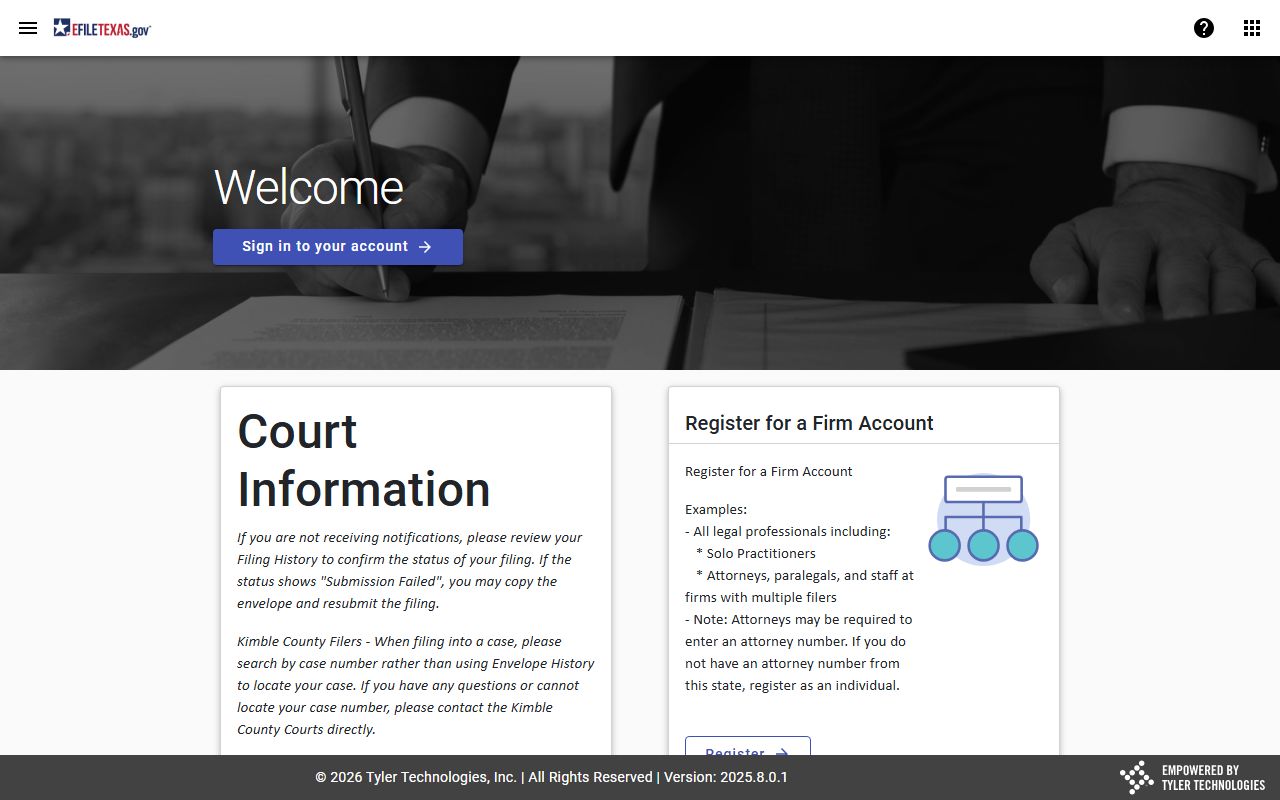
The eFile Texas system covers Uvalde County, allowing remote filing and access to case information through the statewide portal.
Uvalde County Divorce Filing Fees
Uvalde County divorce filing fees follow the Texas state schedule plus local court costs. The total base filing fee for a divorce in most Texas counties of this size runs around $300. That amount includes both state consolidated fees and local charges for courthouse security, law library, records management, and court reporter. Call the Uvalde County District Clerk at (830) 278-3918 to confirm the current fee total before filing, as amounts can change with state and local fee schedule updates.
After filing, additional costs may apply. Serving the other party through a constable or process server adds to the total. Certified copies of the final decree cost $1 per page plus a $5 certification charge. Plain copies are $1 per page. For mail requests, include a self-addressed stamped envelope and the appropriate payment. Ask the clerk whether they accept money orders, cashier's checks, or other forms of payment when you call ahead.
Fee waivers are available for people who cannot afford court costs in Texas. File a Statement of Inability to Afford Payment of Court Costs under Texas Rule of Civil Procedure 145. Official forms for this request are at txcourts.gov. The court reviews your financial information and decides whether to grant the waiver.
Note: Always confirm current fee amounts with the Uvalde County District Clerk before filing or sending payment.
Filing for Divorce in Uvalde County
Uvalde County divorces are heard in the 38th District Court. All cases follow Texas state law under Texas Family Code Chapter 6. Every document from the initial petition to the signed final decree becomes a record kept by the District Clerk in Uvalde.
The residency requirement applies. Under Texas Family Code Section 6.301, at least one spouse must have lived in Texas for six months and in Uvalde County for 90 days before filing. Most residents of the Uvalde area who file here have lived in the county long enough to satisfy this requirement without issue.
Most divorces in Uvalde County are filed on no-fault grounds. The insupportability ground under Texas Family Code Section 6.001 does not require proof of wrongdoing. It simply means the marriage has broken down with no reasonable chance of reconciliation. Fault-based grounds are also available under Texas law when the circumstances warrant them. After the petition is filed, a mandatory 60-day waiting period applies under Texas Family Code Section 6.702.
Property division follows community property principles under Texas Family Code Chapter 7. The court divides the community estate in a just and right manner. Each spouse's separate property stays with them. Spousal maintenance, where applicable, is governed by Texas Family Code Chapter 8.
Uvalde County Divorce Decree Contents
Divorce case files at the Uvalde County District Clerk's office hold everything filed from start to finish. The original petition opens the record. Temporary orders, service documents, financial affidavits, and settlement papers all become part of the file as the case progresses. The Final Decree of Divorce closes the case and becomes the permanent court order governing the terms of the dissolution.
The final decree is the document most people need to produce for legal purposes after a divorce. It covers property and debt division, conservatorship of children, possession schedules, child support, and spousal maintenance. Certified copies are used for name changes, real estate transactions, updating government records, and handling financial accounts. The District Clerk can certify copies for a per-page fee plus a certification charge.
Most divorce records in Uvalde County are public. You do not need to be a party to the case to request copies. Some documents may be sealed by court order. The clerk can tell you what is available in a specific case when you inquire. For a quick check without requesting full documents, the Texas DSHS at dshs.texas.gov can confirm whether a divorce appears in the statewide index.
Legal Help in Uvalde County
People in Uvalde County who need legal assistance with a divorce can reach out to legal aid organizations serving South Texas. Texas RioGrande Legal Aid covers a wide area of South Texas and handles family law matters including divorce and custody for income-eligible clients. Contact information and eligibility details are available through TexasLawHelp.org, which also has free self-help guides and official court forms for filing on your own.
The Texas State Law Library divorce guide covers every step of the divorce process in plain language. All official court forms are at txcourts.gov. For a family law attorney in the Uvalde area, call the State Bar of Texas referral line at (800) 252-9690. For child support services, the Texas Attorney General's Child Support Division handles establishment and enforcement across all Texas counties.
Cities in Uvalde County
No qualifying cities over 100,000 population are located in Uvalde County. Uvalde is the county seat and home of the District Court. All divorce filings for the county go through the courthouse there.
Nearby Counties
Uvalde County is in South Texas and borders these counties. Check where you have lived for at least 90 days before filing for divorce to make sure you file in the right county.