
Bailey County Divorce Decree Lookup
Bailey County divorce decree records go back to 1919 when the county became independent and are kept by the District Clerk in Muleshoe. If you need to find a divorce decree filed in Bailey County or get a certified copy, the clerk's office at the courthouse in Muleshoe handles all records requests in person and by mail. This page explains how to search Bailey County divorce records, what fees apply, and how the Texas divorce filing process works for residents of this South Plains county.
Bailey County Overview
Bailey County District Clerk
The Bailey County District Clerk at the courthouse in Muleshoe handles all divorce records for the county. Staff can search by party name or case number and make copies for you. Divorce records in Bailey County date from 1919, when the county became independent. For records before that date, Bailey County was attached to several other counties, so older records may be harder to locate.
The courthouse is at 300 S 1st Street in Muleshoe. Hours are typical courthouse hours Monday through Friday. Because Bailey County is small, calling ahead before visiting is a good idea. This lets the clerk prepare for your request and reduces wait time. The county's online presence is limited, so most record searches need to happen by phone or in person.
| Office | Bailey County District Clerk |
|---|---|
| Address | 300 S 1st Street, Suite 200 Muleshoe, TX 79347 |
| Phone | (806) 272-3044 |
| Fax | (806) 272-3538 |
| Hours | Monday through Friday, 8:30 AM to 12:00 PM and 1:00 PM to 5:00 PM |
Searching Bailey County Divorce Records
Bailey County has limited online access for divorce records. The statewide re:SearchTX portal is the best starting point for remote searches. Enter the names of both parties and filter by Bailey County if the option is available. For cases not found in re:SearchTX, call the clerk's office directly.
For in-person searches, go to the Bailey County courthouse at 300 S 1st Street in Muleshoe. Give the clerk both party names and the approximate year of the divorce. A cause number helps, but it is not required. Staff can pull the case file and make copies. Call ahead if you are coming from out of town, as staff availability may affect how quickly your request is handled.
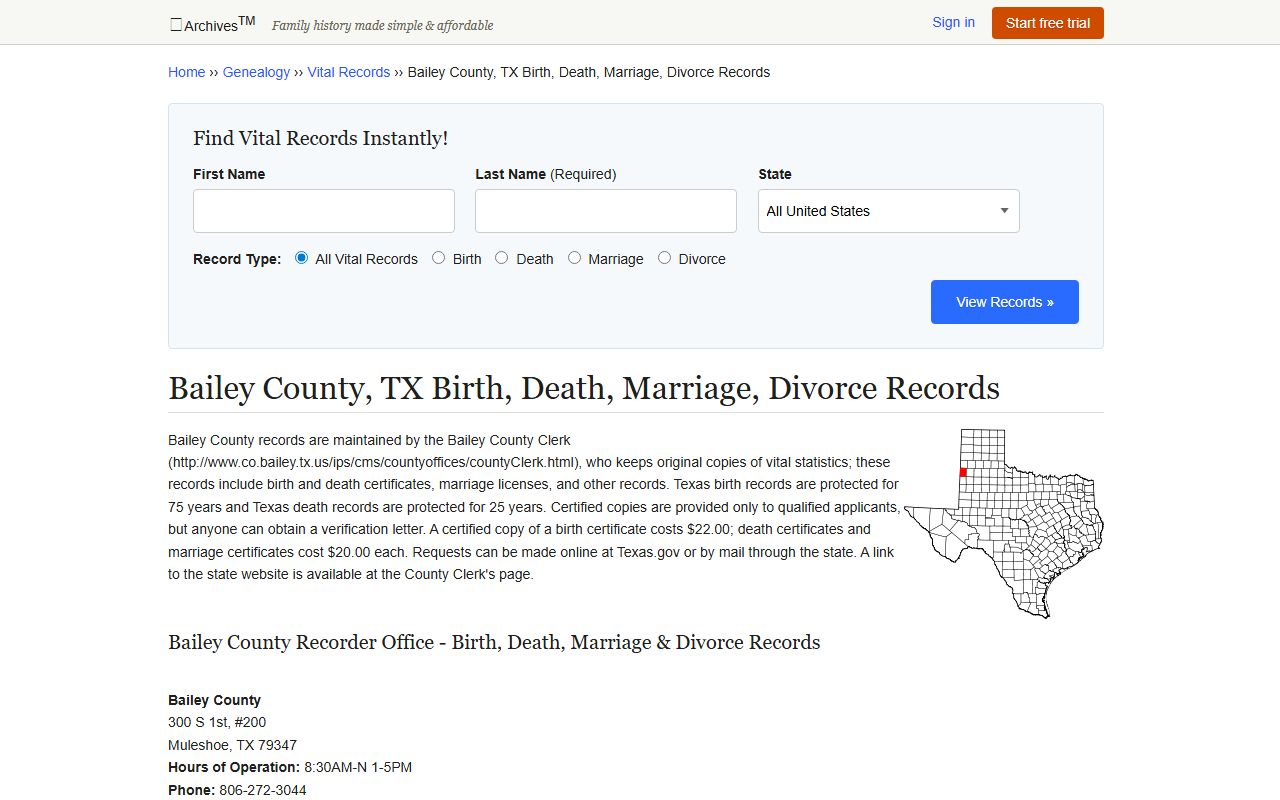
Bailey County vital records information documents the county's records holdings including divorce filings maintained by the District Clerk going back to 1919.
Bailey County's courthouse in Muleshoe holds the official divorce decree records for all cases filed in the county's District Court.
For divorce verifications, the Texas Department of State Health Services at dshs.texas.gov/vs can provide official verification for cases from 1968 onward. This costs $20.00 per copy. For older cases, you need the District Clerk directly.
Note: Because Bailey County became independent in 1919, the earliest divorce records on file with the current District Clerk date to that year. Records before 1919 may exist in other counties to which Bailey was attached.Bailey County Divorce Fees
Divorce filing fees in Bailey County follow the state schedule. The base fee for a new case is around $300. This includes required statutory surcharges. Cases involving children may cost a bit more. Confirm the exact amount with the District Clerk before you file, as fees can change with statutory updates.
Copies of divorce records cost $1.00 per page for plain copies. Certified copies carry a $5.00 certification fee on top of the per-page cost. If you need copies mailed, include a self-addressed stamped envelope or ask about mailing costs when you call. Payment methods include check and money order; call to ask about cash or card.
Fee waivers are available for people who cannot pay. File a Statement of Inability to Afford Payment of Court Costs under Texas Rule of Civil Procedure 145. Include proof of low income or public benefits. The form is at the courthouse or at txcourts.gov/rules-forms. The court decides whether you qualify.
Divorce Filing Process in Bailey County
Bailey County divorces follow Texas Family Code Chapter 6. The residency requirement under Section 6.301 requires that one spouse has lived in Texas for six months and in Bailey County for at least 90 days before filing.
The most common divorce ground is insupportability under Section 6.001, a no-fault approach that does not require either party to prove wrongdoing. Fault grounds like adultery, cruelty, or abandonment can be used and may affect property division under Texas Family Code Chapter 7.
After filing, the 60-day waiting period under Section 6.702 begins. The other spouse must be served or sign a waiver. If both agree on all terms, the case can be resolved quickly after the waiting period. Contested cases go to mediation or trial. When the judge signs the Final Decree of Divorce, that document is filed with the Bailey County District Clerk and becomes the official record.
Electronic filing in Bailey County goes through eFileTexas.gov. If you are not sure whether e-filing is required for your case type in this county, call the clerk before submitting anything.
Bailey County Divorce Decree Contents
The Final Decree of Divorce in Bailey County covers all the terms the judge ordered. This includes how property and debts are divided, any spousal maintenance amounts, child conservatorship arrangements, possession and access schedules, and child support. It is the document you need for name changes, real estate transactions, and proving your marital status.
The full case file held by the District Clerk also contains the original petition, temporary orders, financial documents, and any agreements or motions from the case. Most records from 1919 onward are available at the courthouse. Very old records may require additional research.
Most Bailey County divorce records are public. You do not have to be a party to ask for copies. Some details, like Social Security numbers, are redacted. Cases involving protective orders or domestic violence may have restricted access. Ask the clerk when you make your request.
Legal Help in Bailey County
For self-represented filers, TexasLawHelp.org has free guides and downloadable court forms for Texas divorces. The Texas State Law Library divorce guide is a free reference that explains the process clearly. Official court forms are at txcourts.gov/rules-forms.
For attorney referrals, call the State Bar of Texas at (800) 252-9690. If your case involves child support, the Texas Attorney General's Child Support Division handles enforcement and modifications statewide. Legal aid organizations in the South Plains area can also provide guidance for qualifying residents.
Cities in Bailey County
Bailey County's main community is Muleshoe, the county seat. All divorce cases filed in Bailey County go through the District Clerk in Muleshoe regardless of where in the county you live.
No cities in Bailey County meet the population threshold for a dedicated page. Muleshoe is the largest city in the county. All residents use the Bailey County District Clerk for divorce records and filings.
Nearby Counties
These South Plains counties border Bailey County. Verify your 90-day residence in Bailey County before filing your divorce petition.