
Walker County Divorce Decree Records
Walker County divorce decree records are kept by the District Clerk in Huntsville. If you need to search for a divorce case, look up a final decree, or get a certified copy of a judgment, the District Clerk's office handles all of that. Walker County serves the 12th and 278th Judicial Districts. The courthouse is on University Avenue in Huntsville, and cases can also be searched online through the state's re:SearchTX portal. Whether your case is recent or goes back many years, the Walker County District Clerk is the right place to start.
Walker County Overview
Walker County District Clerk
The District Clerk is Leslie Woolley. This office supports both the 12th and 278th Judicial District Courts, plus the County Court at Law. The District Clerk keeps all court documents and handles requests for copies of divorce decrees and other case records. Staff can be reached by phone, fax, email, or through e-filing.
Divorces in Walker County can be filed in either the County Court at Law or one of the two district courts. Cases are alternated between the 12th and 278th Judicial Districts. If you are not sure which court has your case, you can search online or call the office directly. The clerk can look up cases by name or by cause number.
| Office | Walker County District Clerk |
|---|---|
| Address |
1100 University Ave., Room 209 Huntsville, Texas 77340 |
| Phone | (936) 436-4972 |
| Fax | (936) 436-4973 |
| wcdc@co.walker.tx.us | |
| Website | co.walker.tx.us |
Note: The office provides a fee schedule on the county website, updated for 2025. Download it before you go so you know what to bring.
Search Walker County Divorce Decree Records
Walker County offers two main ways to search divorce decree records: online or in person at the courthouse. The statewide re:SearchTX portal lets you view documents in any case at no cost after creating a free account. You can also use eFileTexas to file documents if you have an active case. The login for both systems is the same.
To search online, go to re:SearchTX and look up your case by party name or cause number. The system shows all filings, orders, and judgments. You can set up alerts to get notified of new activity in a case. This is useful if you are waiting on a final decree or tracking an ongoing proceeding. Not all documents may be viewable without a subscription, but basic case data is free.
For in-person searches, go to Room 209 at 1100 University Ave in Huntsville. Staff will look up your case and make copies. Bring a valid photo ID. If you know the cause number, the search is faster. Without it, they will search by name. Certified copies cost more than plain copies.
The county's public access to court records is also available at texascountiesdeliver.org. This gives index-level access to many Walker County cases. Full document images may require an in-person visit or certified request.
Walker County Divorce Filing Fees
The Walker County District Clerk uses a fee schedule updated in 2025. Filing a new divorce case, annulment, parent-child matter, name change, or adoption costs $350.00. This base fee covers the core statutory charges required by the state.
Other costs can add up. Serving the other spouse through a constable or process server costs extra. If child support is part of the case, the court will require a Record of Support Form for the Texas State Disbursement Unit. There is also a Bureau of Vital Statistics form required for every divorce filed in Texas.
Copies of divorce decrees and other documents cost $1.00 per page for plain copies. Certified copies cost $1.00 per page plus a $5.00 certification fee per document. If you need a name search and do not have a cause number, there may be a search fee as well. Payment can be made by cash, check, money order, or credit card at the courthouse.
Fee waivers are available for people who cannot afford to pay. File a Statement of Inability to Afford Payment of Court Costs. Forms are on the Texas courts website at txcourts.gov. The court will review your income and decide if you qualify.
Divorce Decree Process in Walker County
Divorce cases in Walker County follow Texas state law. The process starts when one spouse files an Original Petition for Divorce with the District Clerk. Under Texas Family Code Section 6.301, one spouse must have lived in Texas for six months and in Walker County for at least 90 days before filing.
Texas allows divorce on no-fault grounds under Section 6.001, which is called insupportability. This means the marriage cannot continue because of conflict or discord with no real chance of getting better. Fault grounds like cruelty, adultery, or abandonment are also allowed but require more proof.
Once the petition is filed, Texas law requires a 60-day waiting period before a judge can sign the Final Decree of Divorce. This rule is set out in Section 6.702. There are exceptions for family violence cases. After the 60 days, if both parties agree on all terms, the judge can sign the decree without a trial. Contested cases take longer and may go through mediation or a hearing.
Walker County has a Standing Restraining Order that goes into effect when the case is filed. This order limits what either spouse can do with marital property or funds while the case is open. Property division in Texas follows community property rules under Texas Family Code Chapter 7.
Walker County's divorce filing information page has details on required forms, standing orders, and the e-filing process.
The Texas State Law Library at guides.sll.texas.gov/divorce has a free guide on how to file for divorce in Texas with or without a lawyer.
What a Walker County Divorce Decree Contains
A divorce decree from Walker County is a court order signed by the judge. It is the final document that ends the marriage and sets out all the terms. Most people need a certified copy of the decree for things like changing a name, refinancing a loan, or proving marital status.
The Final Decree of Divorce typically includes the names of both spouses, the date of marriage, and the date the court signed the order. It spells out how property and debts are divided. If the couple has children, the decree includes a conservatorship order showing who has rights and duties, a possession schedule, and any child support amounts. Spousal maintenance, if ordered, is also in the decree.
The court file also holds other documents: the original petition, any motions or hearings that took place, financial disclosures, and the Bureau of Vital Statistics form required by the state. Under Texas law, most divorce records are public. Some information about children, and some financial exhibits, may be restricted. The Texas DSHS Vital Statistics office keeps a divorce verification index going back to 1968, but it does not issue certified copies of decrees. For certified copies, you go to Walker County.
Note: Bring a valid photo ID when you request copies. Staff will need to verify your identity before releasing documents.
Legal Resources for Walker County Divorce
Walker County residents have access to several resources for divorce cases. The Texas courts' self-help forms are at txcourts.gov/rules-forms. These are the official forms used in Texas courts. TexasLawHelp at texaslawhelp.org has free guides on divorce, custody, and support for people who do not have a lawyer.
The State Bar of Texas runs a lawyer referral service at (800) 252-9690. You can also search for attorneys at texasbar.com. If child support is part of your case, the Texas Attorney General's Child Support Division can help with enforcement and modification after the decree is final.
The Walker County District Clerk's website at co.walker.tx.us has links to the fee schedule, the divorce information page, and contacts for each division. The Texas Judicial Branch website at txcourts.gov has resources on court procedures and statewide rules.
The Texas State Law Library divorce guide covers steps, forms, and resources for anyone going through the process in Texas.
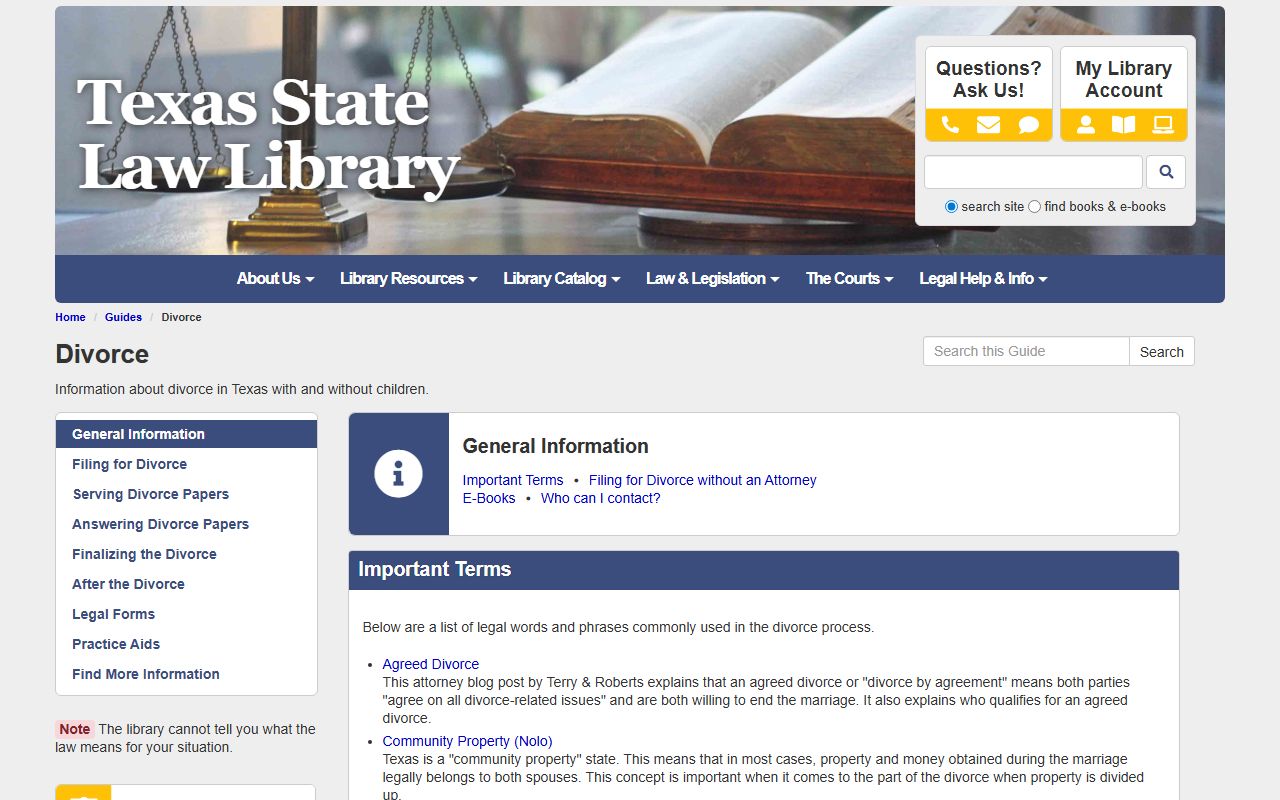
Walker County residents can use this guide to understand their rights and what to expect when searching for or filing a divorce decree.
Cities in Walker County
Walker County includes Huntsville and several smaller communities. All divorce cases in the county go through the Walker County District Court in Huntsville. No cities in Walker County meet the population threshold for a dedicated city page.
Huntsville is the county seat and home to the District Clerk's office. Other communities in the county include New Waverly, Riverside, and Dodge. If you live in any of these areas, file at the Walker County District Clerk's office on University Avenue.
Nearby Counties
These counties border Walker County. Each has its own District Clerk and courthouse. File in the county where you or your spouse has lived for at least 90 days.