
Shelby County Divorce Decree Records
Shelby County divorce decree records are kept at the District Clerk's office in Center, Texas. If you need to search for a divorce case or get a certified copy of a final decree, the District Clerk handles all family law filings for the county. The office covers cases in the 273rd District Court and maintains divorce records going back many decades. You can search in person, send a written request by mail, or use the statewide re:SearchTX portal to look up basic case information online.
Shelby County Overview
Shelby County District Clerk
The District Clerk's office is the official keeper of divorce records in Shelby County. The clerk maintains case files for all family law matters handled by the 273rd District Court, which serves Shelby County. Staff can search by party name or cause number, help you find old and recent divorce cases, and process requests for copies of the Final Decree of Divorce.
The courthouse is located in Center, the county seat of Shelby County in deep East Texas. If you plan to visit in person, call ahead to confirm current office hours and ask what you need to bring. The clerk accepts standard forms of payment for copy fees. They cannot provide legal advice, but they can guide you through the records request process.
| Office | Shelby County District Clerk |
|---|---|
| Address | Shelby County Courthouse 200 San Augustine St. Center, TX 75935 |
| Phone | (936) 598-4161 |
| Hours | Monday through Friday, 8:00 AM to 5:00 PM |
| Website | co.shelby.tx.us |
Search Shelby County Divorce Records
There are a few ways to find divorce decree records in Shelby County. The statewide re:SearchTX portal is one of the easiest tools to start with. It covers district courts across Texas, including Shelby County. You can look up cases by party name or cause number at no cost. The system shows docket entries and basic case details. For certified copies of the actual divorce decree, you still need to contact the District Clerk directly.
In-person searches work well if you need full access to the case file. Come to the Shelby County Courthouse in Center and ask the District Clerk's staff to pull the case. Bring the full name of one or both parties, the year the divorce was filed, and the cause number if you have it. Clerks can locate files and tell you what is available to copy.
Mail requests are also accepted. Write a letter to the Shelby County District Clerk with the names of the parties and the approximate year of filing. Include a check or money order for the copy fees and a self-addressed stamped envelope if you want paper copies returned to you. Allow several business days for the office to process your request.
Note: Online access in Shelby County is limited compared to larger metro counties. The in-person or mail option may be your best route for full documents.
Texas DSHS Vital Statistics can also issue a divorce verification letter for divorces from 1968 forward. This is not a certified copy of the decree, but it does confirm that a divorce took place and is useful when you just need proof of the divorce rather than the full judgment.
[Lead-in: The Texas State Law Library divorce guide covers how to search for and obtain divorce records across Texas counties.]
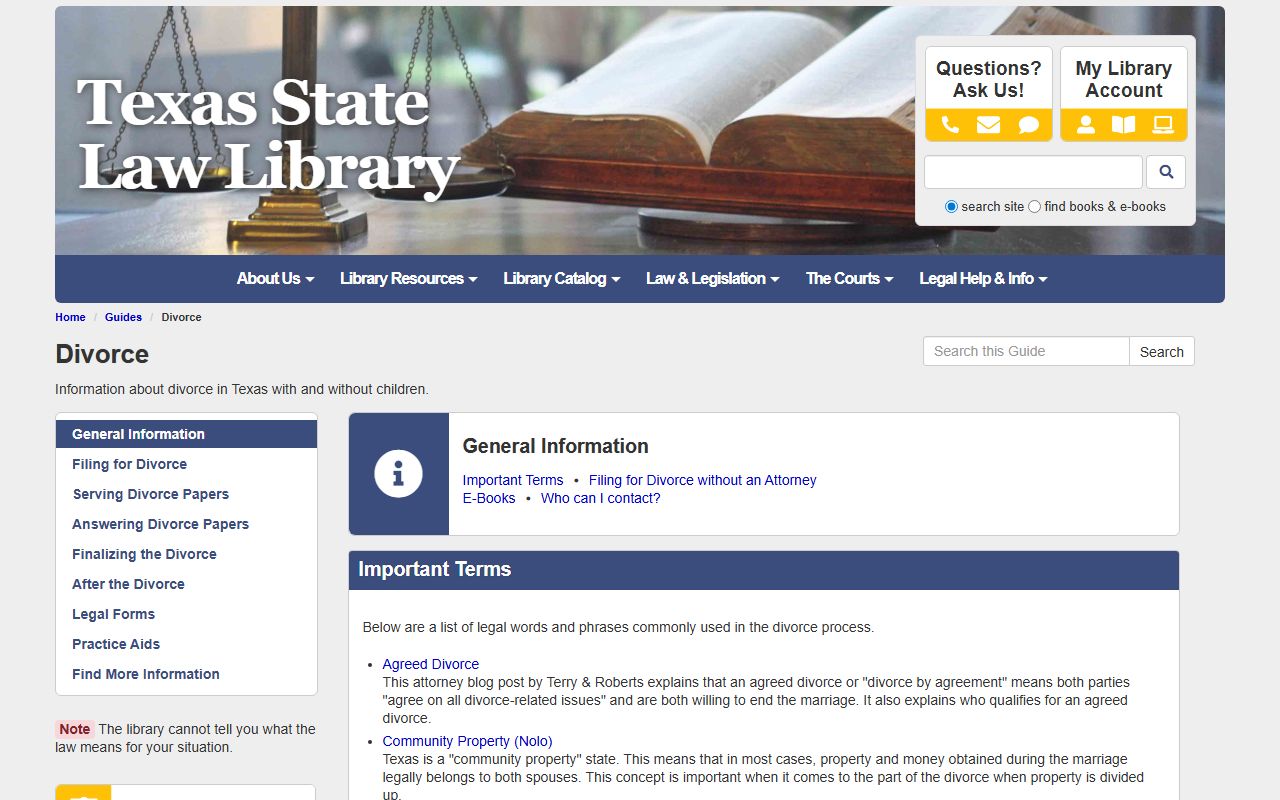
The Texas State Law Library guide walks you through the process for requesting divorce records at the county and state level, including Shelby County.
Shelby County Divorce Decree Fees
Filing fees in Shelby County follow the state fee schedule plus any local court costs. Total filing costs generally run around $300, though the exact amount depends on the case type and what you include in your petition. Cases with children may cost a bit more. The clerk collects fees at the time of filing. No refunds are issued for fees under $10.
After you file, you may have additional costs. If the other spouse must be served by a constable, that runs extra. Certified copies of the final decree carry a per-page fee plus a certification charge. Ask the clerk for the current fee schedule before you request copies. Fees can change and the office's posted schedule is the most up-to-date source.
Fee waivers are available under Texas law. If you cannot afford the filing costs, you can file a Statement of Inability to Afford Payment of Court Costs under Texas Rule of Civil Procedure 145. You provide proof of your financial situation. The court reviews it and determines whether a waiver applies. Official forms are available at txcourts.gov.
Filing for Divorce in Shelby County
Divorce cases in Shelby County go through the 273rd District Court. Texas state law under Texas Family Code Chapter 6 governs the process from start to finish. Each filing, motion, and order becomes part of the permanent case record held by the District Clerk.
First, check that you meet the residency requirement. Under Texas Family Code Section 6.301, at least one spouse must have lived in Texas for six months and in Shelby County for at least 90 days before the petition is filed. If you recently moved to Center or anywhere else in the county, you may need to wait before you can file here.
Most people in Shelby County file on no-fault grounds. The no-fault basis is insupportability under Texas Family Code Section 6.001. It means the marriage has broken down with no real chance of repair. You do not have to prove wrongdoing. Fault grounds such as cruelty, adultery, or abandonment are also available under the Family Code if they apply.
Once the petition is filed, Texas law requires a 60-day waiting period before the court can sign a final decree. This is set out in Texas Family Code Section 6.702. Most cases take longer than 60 days, especially when property division or child custody issues are involved. Agreed divorces move faster. Contested ones often go to mediation or trial.
Property is divided under community property rules in Texas Family Code Chapter 7. What was acquired during the marriage is community property. What each spouse owned before the marriage, or received as a gift or inheritance, stays separate as long as it was kept distinct from community assets.
What's in a Shelby County Divorce Record
A Shelby County divorce case file typically includes the original petition, which starts the case and outlines what the filing spouse is asking for. From there, the file grows with any temporary orders, responses from the other party, financial disclosures, and mediated agreements. If children are involved, you will find conservatorship agreements and possession schedules in the file as well.
The Final Decree of Divorce is the key document most people request. It is the signed court order that ends the marriage. It spells out who gets what property, the terms of any child conservatorship, the possession and access schedule, child support amounts, and spousal maintenance if ordered. Certified copies of the decree are used to change a name, update financial accounts, or handle real estate transfers.
Most divorce records in Shelby County are public. You don't need to be a party to the case to ask for copies. Some materials may be sealed by court order, including financial source documents like tax returns or items tied to protective orders. If a record is sealed, the clerk will tell you the process for requesting access. The Texas Department of State Health Services at dshs.texas.gov can issue a verification letter if you just need proof that a divorce took place.
Note: If you need a name-change court order as part of your decree, the final decree itself serves that purpose and should be kept in a safe place after you receive it.
Legal Help in Shelby County
People in Shelby County can find legal help through several channels. East Texas Legal Services provides civil legal aid to low-income residents across East Texas, including family law matters like divorce and custody. You can reach their offices through TexasLawHelp.org, which also hosts self-help guides, forms, and step-by-step instructions for people filing without an attorney.
The State Bar of Texas runs a lawyer referral service at (800) 252-9690. If you want to find an attorney in the Center area, that line can connect you. The Texas State Law Library divorce guide is a free resource that explains the full process and links to all the official forms you need. Court forms are also available directly at txcourts.gov. If child support is part of your case, the Texas Attorney General's Child Support Division handles enforcement and modification after the decree is entered.
Cities in Shelby County
No qualifying cities with populations over 100,000 are located in Shelby County. All divorce cases are filed at the Shelby County District Court in Center, Texas.
Nearby Counties
Shelby County sits in deep East Texas and borders several neighboring counties. Check where you have lived for at least 90 days to confirm which county you must file in.