
Find Divorce Decrees in Hays County
Hays County divorce decrees are filed with the District Clerk in San Marcos, Texas. The office keeps records for all divorce cases filed in this fast-growing county south of Austin. You can search for a divorce decree online through the Hays County court portal, in person at the courthouse, or by phone. The District Clerk maintains case files going back many years and can provide certified copies of Final Decrees of Divorce for legal and personal use.
Hays County Overview
Hays County District Clerk Office
The Hays County District Clerk maintains all civil court records in the county, including divorce filings and final decrees. The office is located at the Hays County Government Center in San Marcos. Hays County has grown rapidly over the past two decades as part of the Austin metro area, and the court system has expanded to keep up with the caseload.
Hays County has multiple district courts that handle family law matters. This includes divorce cases, custody disputes, and related proceedings. The District Clerk's office serves as the central records keeper for all of these courts. If you are not sure which court handled a specific case, the clerk can look it up by party name or cause number.
| Office | Hays County District Clerk |
|---|---|
| Address | 712 S. Stagecoach Trail, Ste. 2056 San Marcos, TX 78666 |
| Phone | (512) 393-7660 |
| Hours | Monday through Friday, 8:00 AM to 5:00 PM |
| Website | hayscountycourt.org |
Searching Hays County Divorce Records
Hays County offers online access to court records through its court portal at hayscountycourt.org. You can search by party name or cause number to find case status and docket entries. This is a good starting point for recent cases. For older filings, an in-person visit or phone call to the District Clerk may be needed.
The statewide re:SearchTX system also pulls records from Hays County. You can search for free using a party name. The system shows basic case information, filed documents, and case status. Keep in mind that some documents may not be available to view online, especially sealed records or exhibits with private information.
To search in person, go to the Government Center in San Marcos and ask the District Clerk staff to look up the case. Bring a photo ID and the full name of one party to the divorce, plus the approximate year it was filed. The clerk can print a case summary or provide copies. Certified copies require an extra fee per page.
Note: Online searches work best for cases filed in the last 10-15 years. For very old divorce records, contact the District Clerk directly to ask about archive access.
Divorce Filing in Hays County
To file for divorce in Hays County, at least one spouse must meet the residency rule under Texas Family Code § 6.301. That means six months in Texas and 90 days in Hays County before the petition is filed. If you live in San Marcos, Kyle, Buda, or another Hays County community, you file here.
The most common ground for divorce in Texas is "insupportability" under Texas Family Code § 6.001. This is a no-fault ground and means the marriage has broken down with no reasonable hope of repair. It doesn't require proving fault on either side. Fault grounds like cruelty or adultery are also allowed but require proof.
After filing, there is a mandatory 60-day waiting period under Texas Family Code § 6.702 before a judge can sign the decree. This waiting period applies even when both spouses agree. Exceptions exist in domestic violence cases. If both parties agree on all terms, the process can move forward quickly once the 60 days pass.
Property in Texas is divided under community property rules set in Texas Family Code Chapter 7. The court divides marital assets in a way it finds just and right. Each spouse keeps their separate property, which includes things owned before marriage and gifts or inheritances received during it.
What Hays County Divorce Decrees Contain
The Final Decree of Divorce is the main document in any divorce file. It lists the names of both parties, the date the marriage ended, and all terms agreed to or ordered by the court. This includes property division, any debt allocation, and child-related orders if the couple has kids.
If children are involved, the decree includes conservatorship orders that spell out who has legal and physical rights. The Standard Possession Order is commonly used in Texas and sets a regular schedule for the non-primary parent. Child support amounts are included per Texas Family Code Chapter 154. If one spouse is ordered to pay spousal maintenance, those amounts appear in the decree as well.
The full case file also includes the Original Petition for Divorce, any motions or orders entered during the case, and financial documents. Most of this file is public. Some exhibits, like tax returns or detailed financial statements, may be sealed. Contact the District Clerk to ask about access to specific parts of a case file.
The Texas State Law Library provides a free online guide to the divorce process that covers Hays County and all other Texas counties.
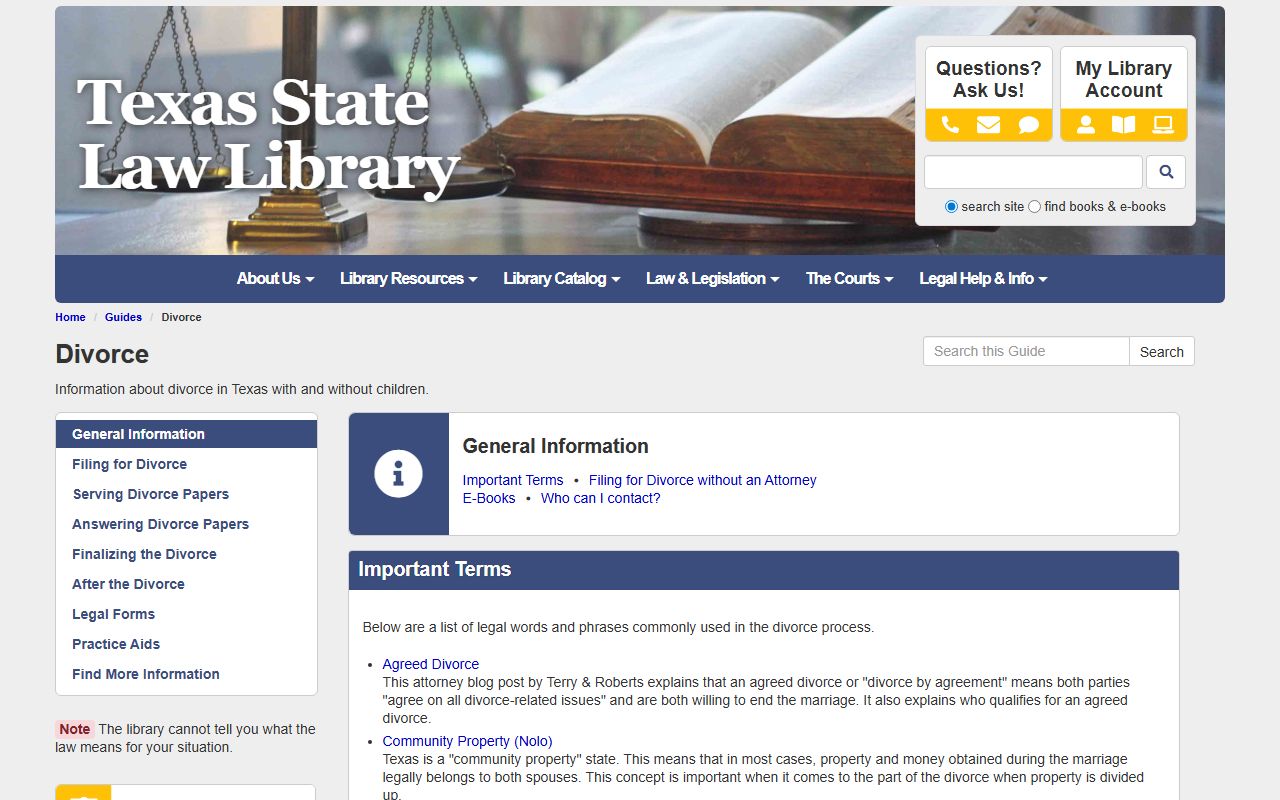
The Law Library guide walks through each step from filing to final decree, and links to the forms you need for a Hays County divorce case.
Legal Resources in Hays County
Hays County residents have several options for legal help with divorce cases. The State Bar of Texas lawyer referral service can connect you with a family law attorney licensed to practice in Texas. Many attorneys in the San Marcos and Austin metro area handle Hays County cases. You can also call the Bar at (800) 252-9690.
TexasLawHelp.org has free guides and court forms for divorce cases. This is especially helpful if you are handling the case without an attorney. Agreed divorces with no contested issues are simpler to do on your own. The site has step-by-step instructions and links to all required forms. Standard court forms are also posted at txcourts.gov.
People with low income may qualify for a filing fee waiver. The form is called the Statement of Inability to Afford Payment of Court Costs and is filed with the District Clerk. The court reviews it and decides if you qualify.
Cities in Hays County
Hays County includes San Marcos, Kyle, Buda, and several other growing communities in the Austin metro area. No city in Hays County currently meets the 100,000-population threshold for a separate city page on this site. All divorce cases in the county are filed with the Hays County District Court in San Marcos regardless of which community you live in.
Nearby Counties
Hays County is surrounded by several other Texas counties. If you need to verify which county handles your case, check your current home address. You file in the county where you or your spouse has lived for the past 90 days.
Neighboring counties include Travis County, Comal County, Caldwell County, Blanco County, and Guadalupe County.